For the most part, the automotive tire industry has dumped the bias tire for on-highway use, but bias type tires are still offered in the ATV, off-road, and agriculture industries.
Radial construction tires:

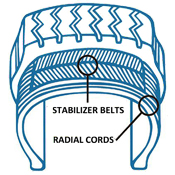 Radial constructed tires utilize ply cords that extend from bead to bead at approximately right angles to the centerline of the tire. They are parallel to each other, and are combined with stabilizer belts.
Advantages: The result is longer tread life, better steering control, lower rolling resistance and fuel savings. Radial tires are best suited for those looking for smoother rides, longer tread life, and higher speed riding.
Disadvantage: Radials tires itend to be more expensive than bias tires, mainly because they cost more to produce initially. However, this is also largely offset by the increased tire life and longevity.
Bias construction tires:
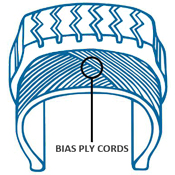 Bias tires typically have the ply cords that extend diagonally from bead to bead at a range of 30 to 40 degree angles. Each successive ply is laid at an opposing angle, forming a criss-cross pattern.
Advantages: The end result is a design that allows the entire tire body to flex, as the tread and sidewalls share the same casing plies. The flex allows for better gripping, better clean out, and conformity to rough and rocky terrain. Bias type tires are best suited for extreme off-road condtions where grip, cleanout, and traction are top priority.
Disadvantages: This tire flex in the bias constructed tire is also its major disadvantage, depending upon the application. Bias tires tend to wear out quicker and form flat spots compared to their counterparts. The flexing also means increased rolling resistance, and less control and traction at higher speeds.
Summary:
| |
Advantages
|
Disadvantages
|
| Bias |
- Lower purchase price
- Good lateral stability (hill side work)
- Good in rough terrain and off-road
- Strong sidewalls, tough casing
- Good tread cleanout
- Easily repaired
|
- Tread wears faster than radials
- Reduced foot print and traction
- Tread flexes more, generating more heat and rolling resistance.
- Greater rolling resistance and fuel inefficiency
- Profile of tire increases soil compaction and reduces traction
|
| Radial |
- Good high speed capacity
- Longer lasting (Up to 50% longer)
- Wear resistant
- Low heat build-up
- Lower rolling resistance
- Better fuel economy
- Better floatation and larger contact area
- Less soil compaction
- Better stability and machine handling
- Smoother, more quiet ride
- Proliferation of tires in the last 10 years has mostly been in radial
|
- Higher purchase price
- More difficult to repair
|
Notes: All radial tires have a designated "R" in the tire size. Example: 26x11Rx12. If you don't see the R, it's a bias type tire.